
Fintech • B2C
Fintech • B2C
Designing a fintech B2C mobile app for credit building
Designing a fintech B2C mobile app for credit building
A closer look at several high-impact product improvements I led - from concept to launch - that shaped Ava’s growth, improved user outcomes, and elevated the company’s overall product strategy.
A closer look at several high-impact product improvements I led - from concept to launch - that shaped Ava’s growth, improved user outcomes, and elevated the company’s overall product strategy.
A closer look at several high-impact product improvements I led - from concept to launch - that shaped Ava’s growth, improved user outcomes, and elevated the company’s overall product strategy.

My Role
My Role
My Role
Founding/Lead Designer
Founding/Lead Designer
Founding/Lead Designer
Industry
Industry
Industry
Fintech, B2C
Fintech, B2C
Fintech, B2C
Timeline
Timeline
Timeline
2023
2023
2023
Context
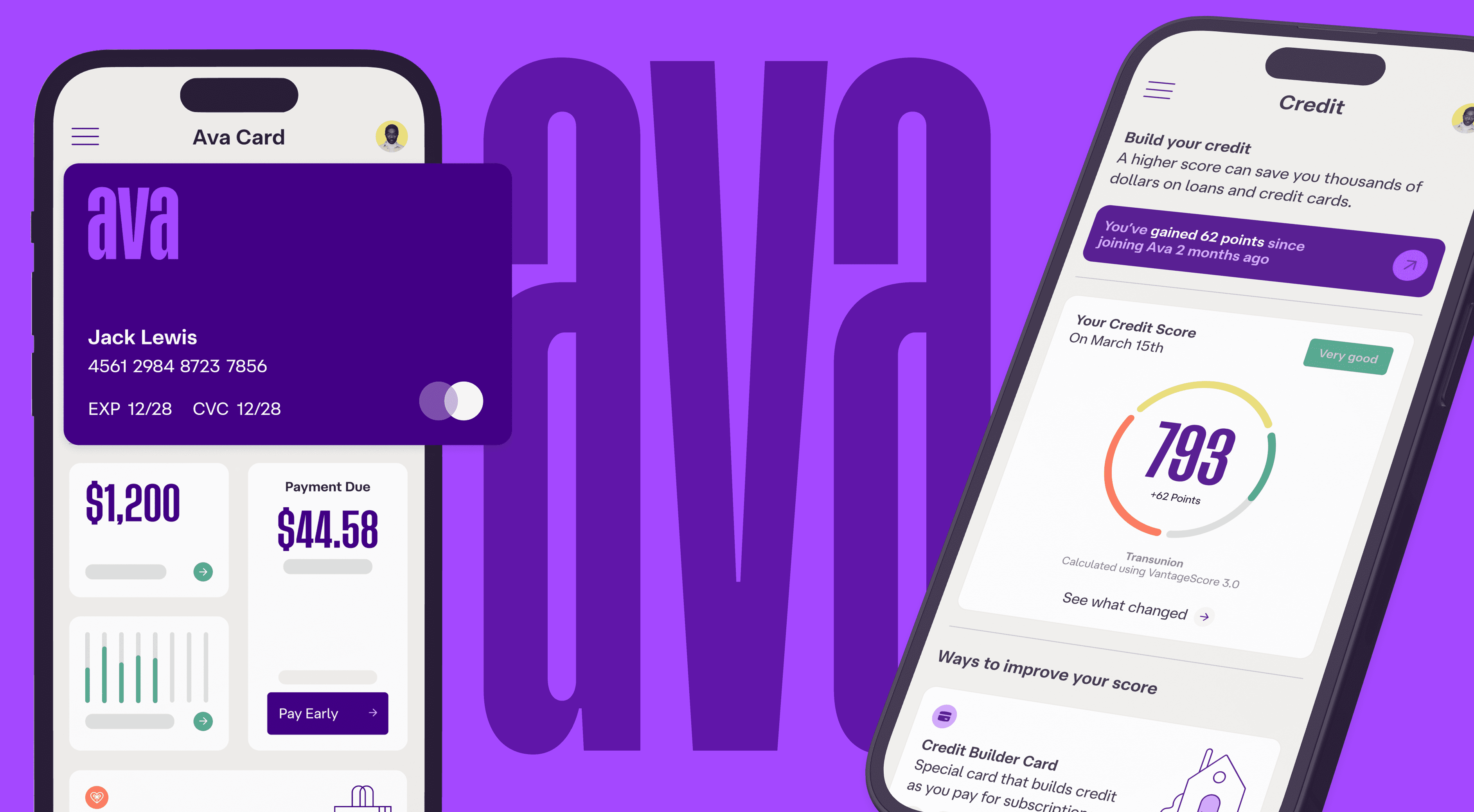
I joined Ava, a fast-growing fintech helping people build credit through a mobile app and financial tools like the Credit Builder Card, Save & Build Loan, and Rent Reporting.
At the time, the product had strong traction but inconsistent UX, unclear onboarding, and fragmented brand identity.
As the sole designer, I led a full redesign of the app and brand - from user research and A/B testing to design system creation and new feature launches - and later grew the design team to three.
Context
I joined Ava, a fast-growing fintech helping people build credit through a mobile app and financial tools like the Credit Builder Card, Save & Build Loan, and Rent Reporting.
At the time, the product had strong traction but inconsistent UX, unclear onboarding, and fragmented brand identity.
As the sole designer, I led a full redesign of the app and brand - from user research and A/B testing to design system creation and new feature launches - and later grew the design team to three.
Context
I joined Ava, a fast-growing fintech helping people build credit through a mobile app and financial tools like the Credit Builder Card, Save & Build Loan, and Rent Reporting.
At the time, the product had strong traction but inconsistent UX, unclear onboarding, and fragmented brand identity.
As the sole designer, I led a full redesign of the app and brand - from user research and A/B testing to design system creation and new feature launches - and later grew the design team to three.
Context
I joined Ava, a fast-growing fintech helping people build credit through a mobile app and financial tools like the Credit Builder Card, Save & Build Loan, and Rent Reporting.
At the time, the product had strong traction but inconsistent UX, unclear onboarding, and fragmented brand identity.
As the sole designer, I led a full redesign of the app and brand - from user research and A/B testing to design system creation and new feature launches - and later grew the design team to three.
+24%
+24%
+24%
Paid conversions
Paid conversions
+38%
+38%
+38%
Bank link success
Bank link success
Bank link success
4.9 ⭐️
4.9 ⭐️
4.9 ⭐️
App Store rating (13K reviews)
App Store rating (13K reviews)
App Store rating (13K reviews)
Scope & responsibilities
Led end-to-end product design for mobile app, website, and marketing
Redesigned onboarding and payment integrations to increase activation
Introduced new features: Credit Score dashboard, Debt tab, Rent Reporting
Built a unified design system and brand refresh used across teams
Collaborated with engineering, growth, and leadership on roadmap definition
Ran usability testing and multi-variant experiments to validate design hypotheses
Scope & responsibilities
Led end-to-end product design for mobile app, website, and marketing
Redesigned onboarding and payment integrations to increase activation
Introduced new features: Credit Score dashboard, Debt tab, Rent Reporting
Built a unified design system and brand refresh used across teams
Collaborated with engineering, growth, and leadership on roadmap definition
Ran usability testing and multi-variant experiments to validate design hypotheses
Scope & responsibilities
Led end-to-end product design for mobile app, website, and marketing
Redesigned onboarding and payment integrations to increase activation
Introduced new features: Credit Score dashboard, Debt tab, Rent Reporting
Built a unified design system and brand refresh used across teams
Collaborated with engineering, growth, and leadership on roadmap definition
Ran usability testing and multi-variant experiments to validate design hypotheses
Onboarding redesign - building trust into the first 90 seconds
Onboarding redesign - building trust into the first 90 seconds
Onboarding redesign - building trust into the first 90 seconds
The problem
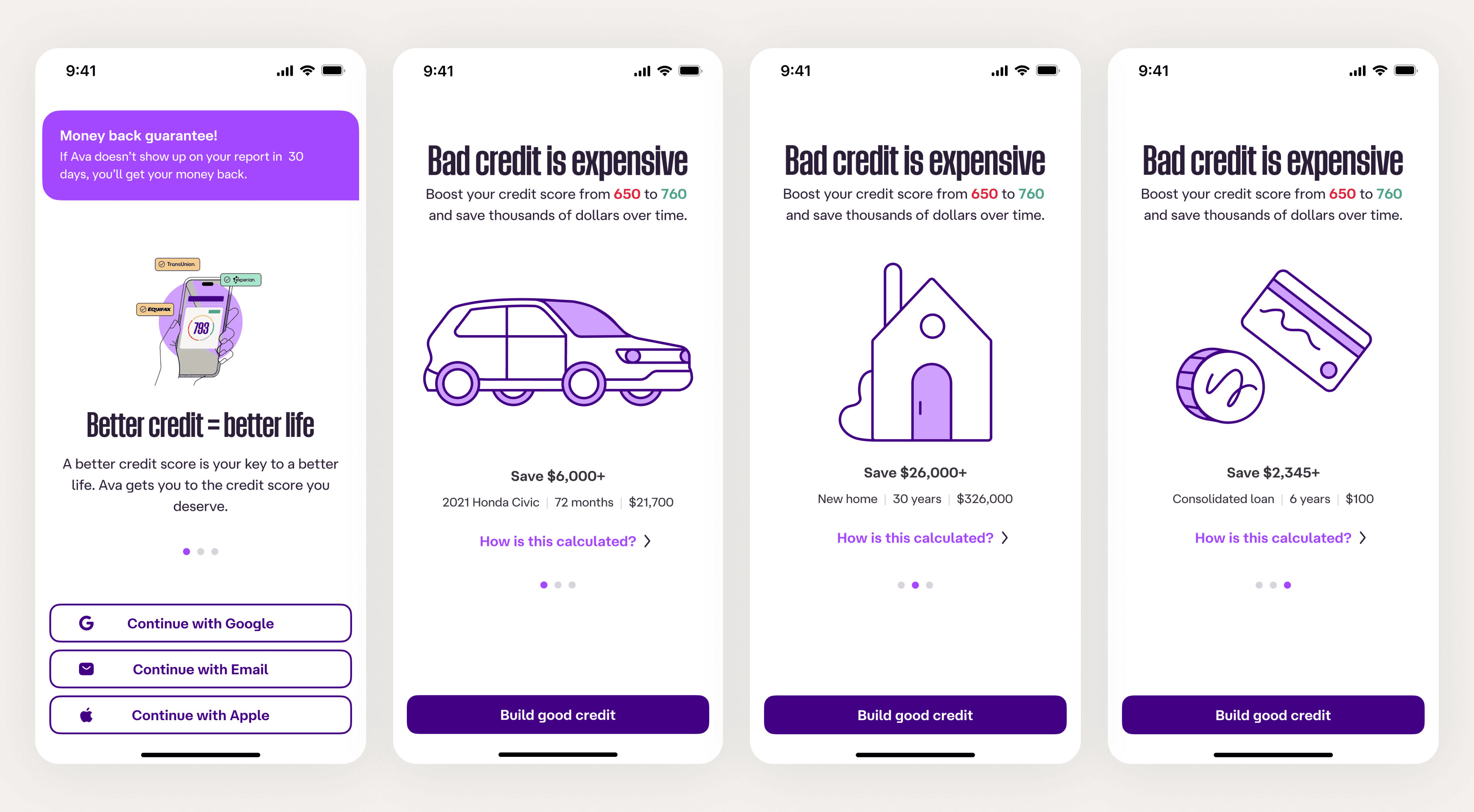
After paying for Ava, users were sent into a set of educational screens (“bad credit is expensive,” savings examples).
I designed these originally to reinforce value - but once in production, data showed a problem:
30–38% of paying users dropped before completing activation.
Most assumed onboarding was over and didn’t expect more reading.
The problem
After paying for Ava, users were sent into a set of educational screens (“bad credit is expensive,” savings examples).
I designed these originally to reinforce value - but once in production, data showed a problem:
30–38% of paying users dropped before completing activation.
Most assumed onboarding was over and didn’t expect more reading.
The problem
After paying for Ava, users were sent into a set of educational screens (“bad credit is expensive,” savings examples).
I designed these originally to reinforce value - but once in production, data showed a problem:
30–38% of paying users dropped before completing activation.
Most assumed onboarding was over and didn’t expect more reading.
Scope & Responsibilities
Led end-to-end product design for mobile app, website, and marketing
Redesigned onboarding and payment integrations to increase activation
Introduced new features: Credit Score dashboard, Debt tab, Rent Reporting
Built a unified design system and brand refresh used across teams
Collaborated with engineering, growth, and leadership on roadmap definition
Ran usability testing and multi-variant experiments to validate design hypotheses
Onboarding redesign - building trust into the first 90 seconds
The problem
After paying for Ava, users were sent into a set of educational screens (“bad credit is expensive,” savings examples).
I designed these originally to reinforce value - but once in production, data showed a problem:
30–38% of paying users dropped before completing activation.
Most assumed onboarding was over and didn’t expect more reading.
Scope & Responsibilities
Led end-to-end product design for mobile app, website, and marketing
Redesigned onboarding and payment integrations to increase activation
Introduced new features: Credit Score dashboard, Debt tab, Rent Reporting
Built a unified design system and brand refresh used across teams
Collaborated with engineering, growth, and leadership on roadmap definition
Ran usability testing and multi-variant experiments to validate design hypotheses
Onboarding redesign - building trust into the first 90 seconds
When I joined Ava, onboarding was the biggest friction point.
Only 52 % of new users finished registration, and most quit when asked to link their bank accounts. The flow was too long, unclear, and didn’t build trust - a critical gap for a fintech product.
My goal: make setup simple, transparent, and fast while improving activation.
Research & Insights
I analyzed funnel data, ran 12 interviews and 20 usability tests, then validated ideas with A/B experiments across 10 K users.
What I learned
68 % of drop-offs happened at the Plaid screen - users didn’t trust the redirect.
Average completion time was 4 ½ min, with too many repetitive steps.
Showing early credit-building progress (“+60 pts in 3 months”) increased motivation by 27 %.
Research
Through funnels, interviews, and screen recordings I learned:
The timing was wrong - users wanted action, not education.
The next step wasn’t obvious, so motivation dropped.
Most people skipped or exited instantly.
This made it clear: the post-purchase moment needed to build momentum, not deliver lessons.
Research
Through funnels, interviews, and screen recordings I learned:
The timing was wrong - users wanted action, not education.
The next step wasn’t obvious, so motivation dropped.
Most people skipped or exited instantly.
This made it clear: the post-purchase moment needed to build momentum, not deliver lessons.
Research
Through funnels, interviews, and screen recordings I learned:
The timing was wrong - users wanted action, not education.
The next step wasn’t obvious, so motivation dropped.
Most people skipped or exited instantly.
This made it clear: the post-purchase moment needed to build momentum, not deliver lessons.
My approach
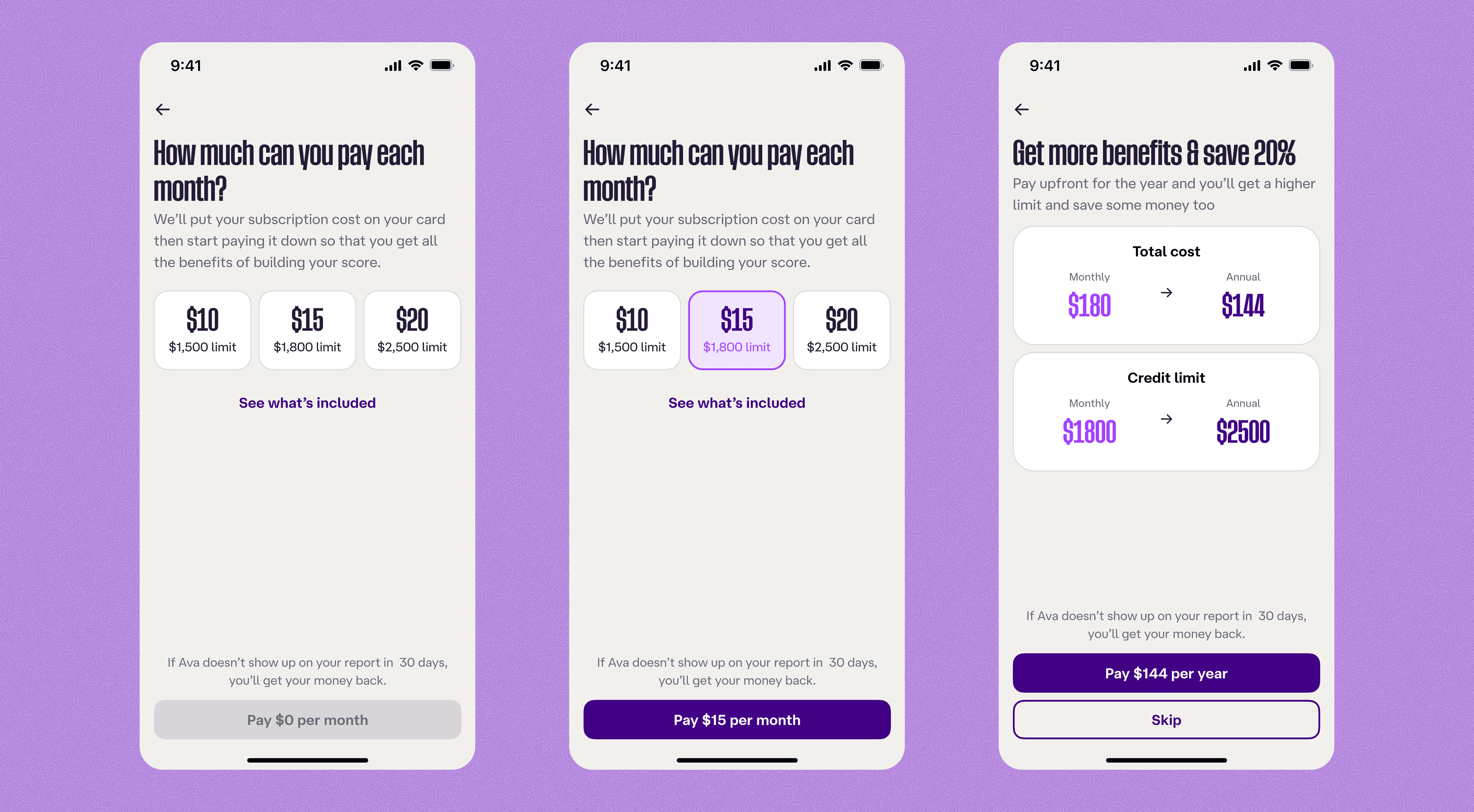
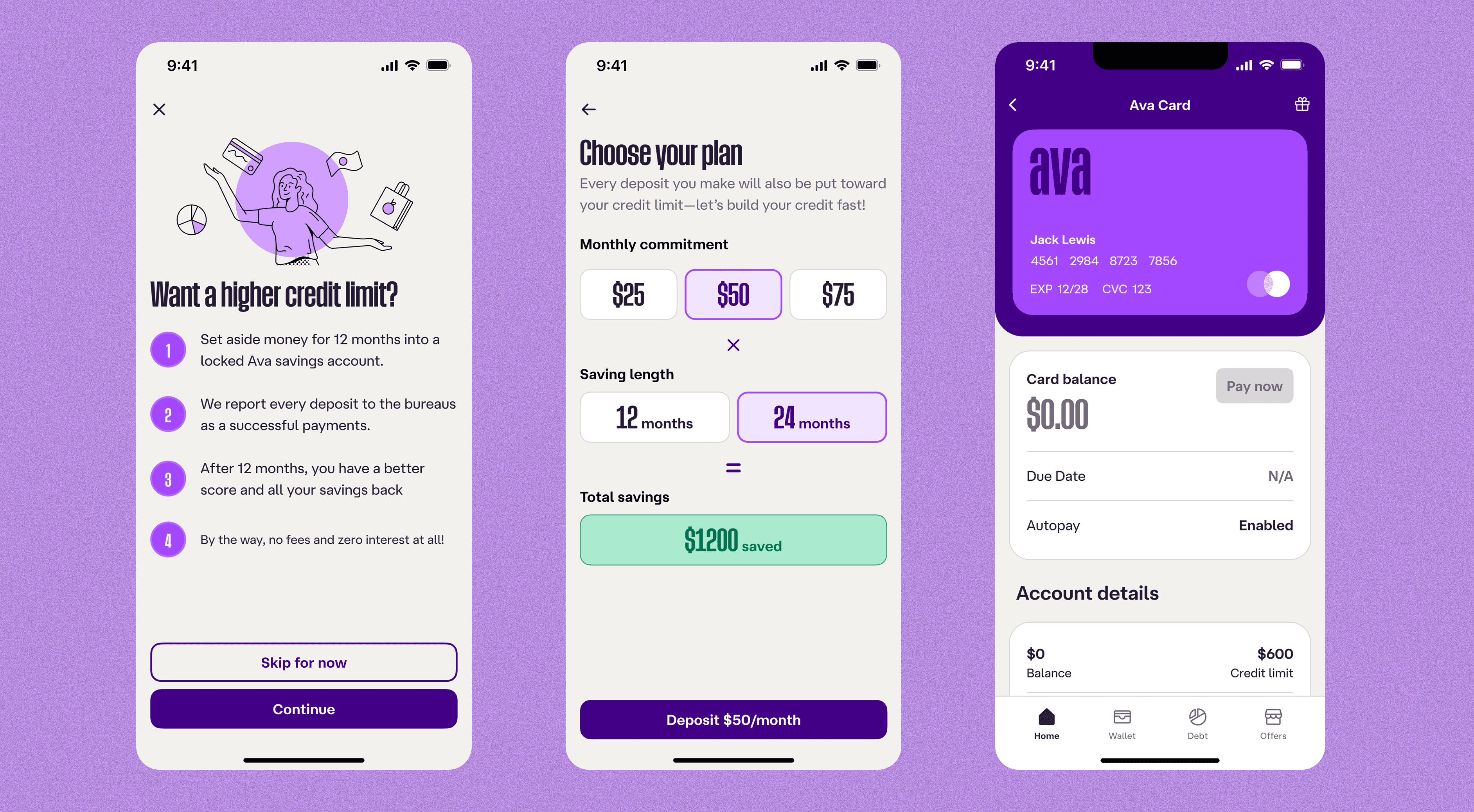
I reframed the flow around one question: “What is the first meaningful action users should take?”
The answer: set their monthly contribution so Ava can start reporting payments immediately.
So I replaced the educational sequence with a short, interactive step: “How much can you pay each month?”
→ Shows credit limit
→ Shows timeline
→ Optional annual upsell
→ Clear “continue” path
This turned a passive sequence into an actionable setup.
My approach
I reframed the flow around one question: “What is the first meaningful action users should take?”
The answer: set their monthly contribution so Ava can start reporting payments immediately.
So I replaced the educational sequence with a short, interactive step: “How much can you pay each month?”
→ Shows credit limit
→ Shows timeline
→ Optional annual upsell
→ Clear “continue” path
This turned a passive sequence into an actionable setup.
My approach
I reframed the flow around one question: “What is the first meaningful action users should take?”
The answer: set their monthly contribution so Ava can start reporting payments immediately.
So I replaced the educational sequence with a short, interactive step: “How much can you pay each month?”
→ Shows credit limit
→ Shows timeline
→ Optional annual upsell
→ Clear “continue” path
This turned a passive sequence into an actionable setup.
Result
Result
Result
+46%
+46%
+46%
Completion
Completion
Completion
+38%
+38%
+38%
Successful bank links
Successful bank links
Successful bank links
+32%
+32%
+32%
More users reaching 1st credit action
More users reaching 1st credit action
More users reaching 1st credit action
My role
My role
My role
Designed both the original and redesigned flows
Led research, A/B testing, and decision-making
Drove UX, UI, copy, and system alignment
Partnered with engineering on logic + states
Created the activation pattern adopted across future Ava features
Designed both the original and redesigned flows
Led research, A/B testing, and decision-making
Drove UX, UI, copy, and system alignment
Partnered with engineering on logic + states
Created the activation pattern adopted across future Ava features
Designed both the original and redesigned flows
Led research, A/B testing, and decision-making
Drove UX, UI, copy, and system alignment
Partnered with engineering on logic + states
Created the activation pattern adopted across future Ava features
Credit Score tab - making the most important screen actually clear
Credit Score tab - making the most important screen actually clear
Credit Score tab - making the most important screen actually clear
The problem
Users saw a single credit score with no context.
This led to constant questions:
“Why did my score change?”
“What does this number mean?”
“Is this accurate?”
The founders wanted this page to build trust and help users understand their credit, not confuse them.
The problem
Users saw a single credit score with no context.
This led to constant questions:
“Why did my score change?”
“What does this number mean?”
“Is this accurate?”
The founders wanted this page to build trust and help users understand their credit, not confuse them.
The problem
Users saw a single credit score with no context.
This led to constant questions:
“Why did my score change?”
“What does this number mean?”
“Is this accurate?”
The founders wanted this page to build trust and help users understand their credit, not confuse them.
My approach
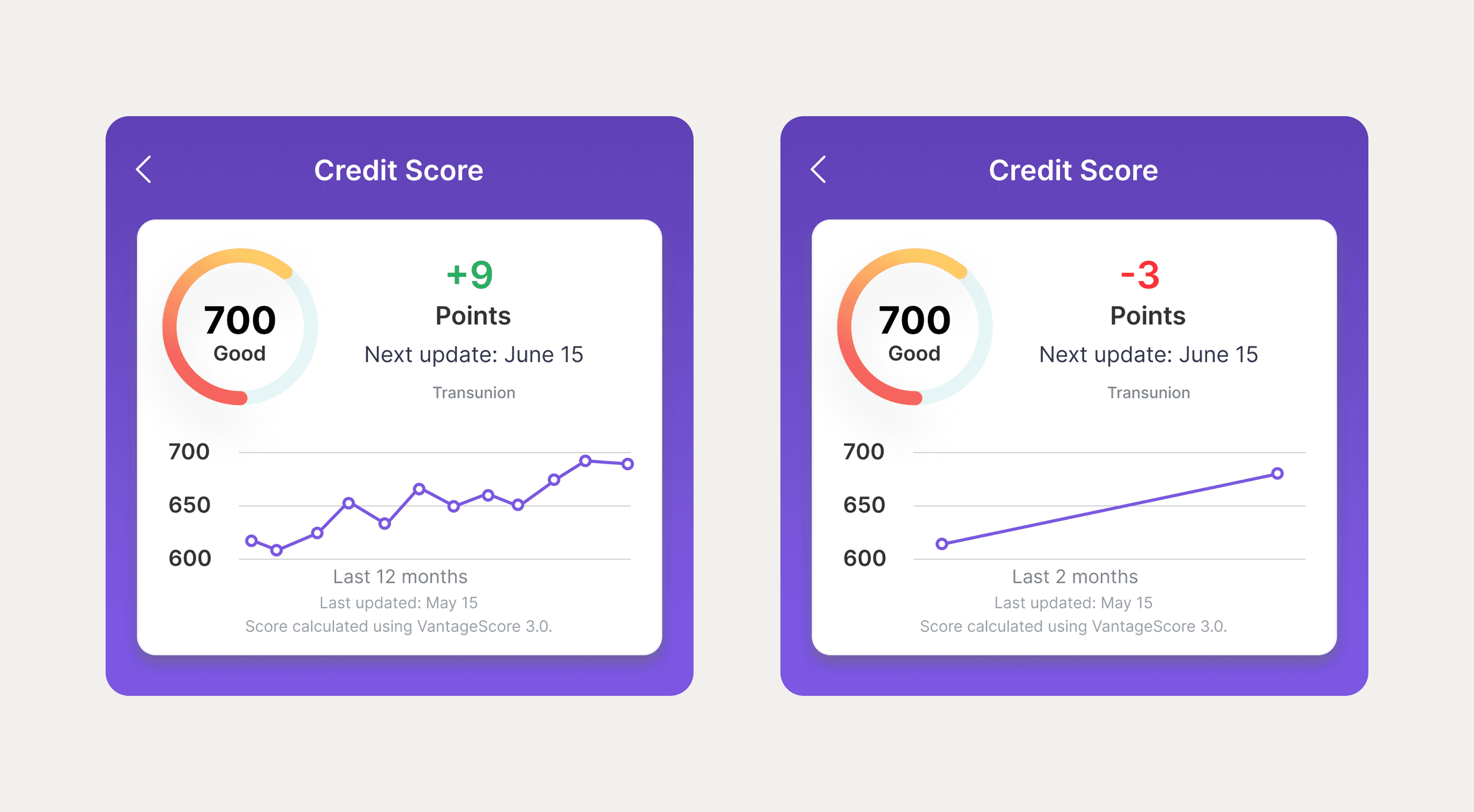
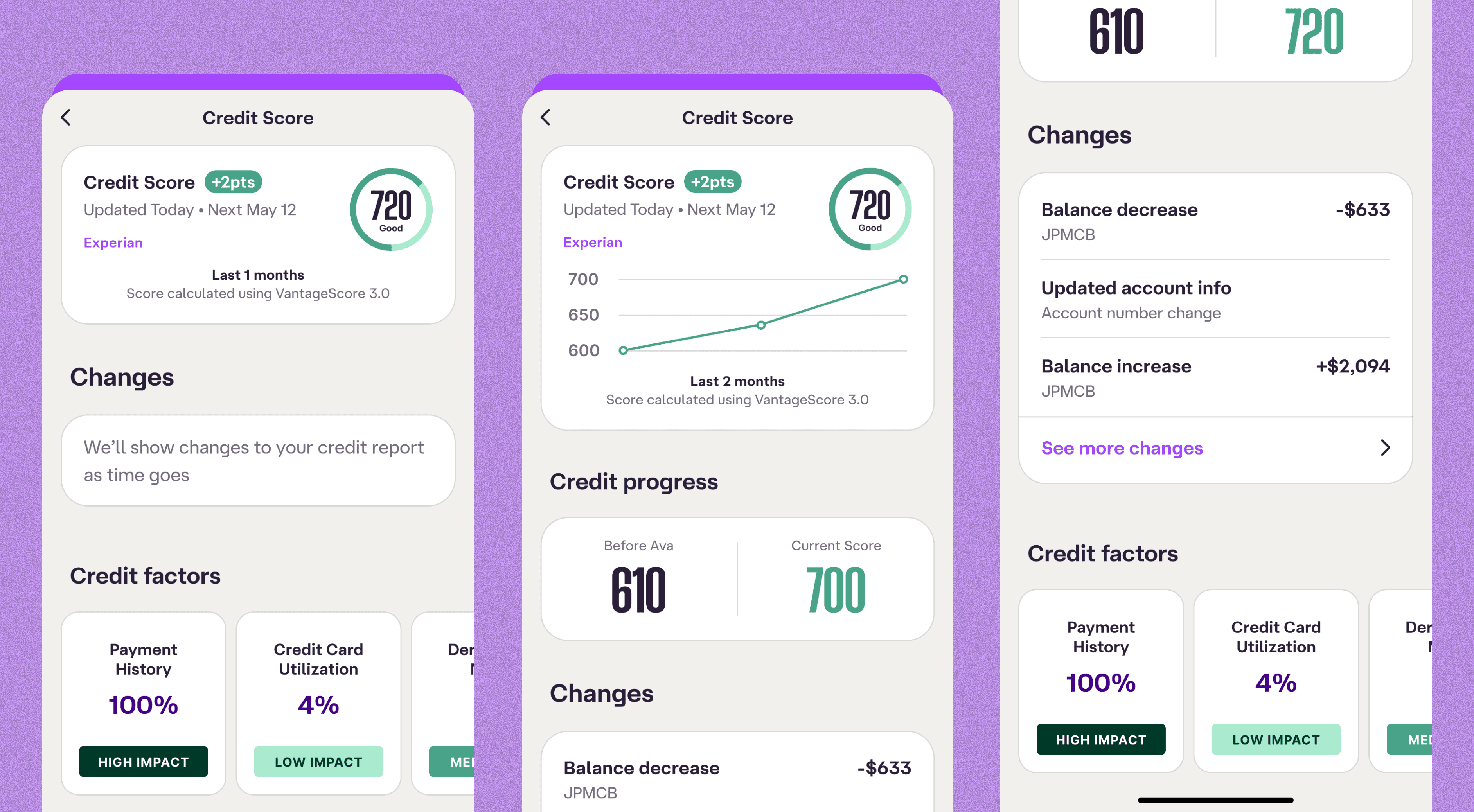
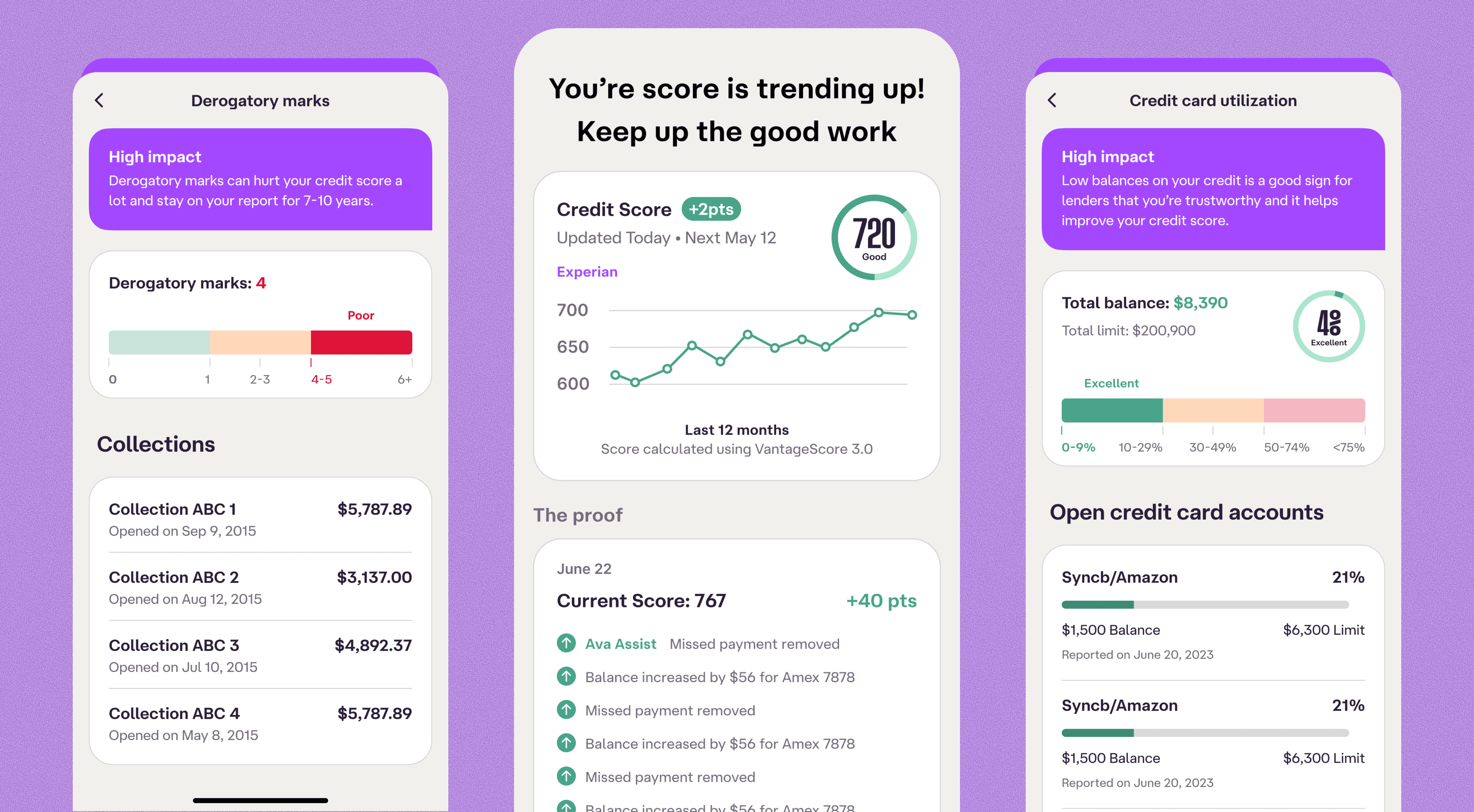
I reviewed support tickets, interviewed users, studied competitors, and mapped every credit state (thin file, one datapoint, full file). One pattern stood out: People don’t trust a number they can’t understand.
So I restructured the screen around three essentials:
Score + trendline → show movement, not just a number.
“Changes” module → simple explanations of what affected the score.
Credit factor breakdown → payment history, utilization, etc., each labeled by impact.
I partnered closely with the founders to define what mattered most and collaborated with engineering to ensure all data was accurate and consistent with bureau logic.
My approach
I reviewed support tickets, interviewed users, studied competitors, and mapped every credit state (thin file, one datapoint, full file). One pattern stood out: People don’t trust a number they can’t understand.
So I restructured the screen around three essentials:
Score + trendline → show movement, not just a number.
“Changes” module → simple explanations of what affected the score.
Credit factor breakdown → payment history, utilization, etc., each labeled by impact.
I partnered closely with the founders to define what mattered most and collaborated with engineering to ensure all data was accurate and consistent with bureau logic.
My approach
I reviewed support tickets, interviewed users, studied competitors, and mapped every credit state (thin file, one datapoint, full file). One pattern stood out: People don’t trust a number they can’t understand.
So I restructured the screen around three essentials:
Score + trendline → show movement, not just a number.
“Changes” module → simple explanations of what affected the score.
Credit factor breakdown → payment history, utilization, etc., each labeled by impact.
I partnered closely with the founders to define what mattered most and collaborated with engineering to ensure all data was accurate and consistent with bureau logic.
Result
Result
Result
-42%
-42%
-42%
Support tickets
Support tickets
Support tickets
2.3x
2.3x
2.3x
More engagement with the tab
More engagement with the tab
+36%
+36%
+36%
User understanding rating
User understanding rating
User understanding rating
Debt tab - making debt simple to understand
Debt tab - making debt simple to understand
Debt tab - making debt simple to understand
The problem
Users knew their credit score, but had zero clarity on their actual debt.
Support logs, analytics, and interviews all showed the same issue:
People didn’t understand their monthly payments, interest, or total obligations - and had no place in Ava to see it.
This was a major gap, so I prioritized fixing it.
The problem
Users knew their credit score, but had zero clarity on their actual debt.
Support logs, analytics, and interviews all showed the same issue:
People didn’t understand their monthly payments, interest, or total obligations - and had no place in Ava to see it.
This was a major gap, so I prioritized fixing it.
The problem
Users knew their credit score, but had zero clarity on their actual debt.
Support logs, analytics, and interviews all showed the same issue:
People didn’t understand their monthly payments, interest, or total obligations - and had no place in Ava to see it.
This was a major gap, so I prioritized fixing it.
My approach
To confirm the problem, I reviewed:
Behavior data → users searched for debt info in the wrong places
Support tickets → most questions were about loan payments + interest
User interviews → almost no one could explain their debt breakdown
Benchmarking → competitors treated debt insights as core value
All signals aligned: A dedicated Debt tab was the right problem to solve.
My approach
To confirm the problem, I reviewed:
Behavior data → users searched for debt info in the wrong places
Support tickets → most questions were about loan payments + interest
User interviews → almost no one could explain their debt breakdown
Benchmarking → competitors treated debt insights as core value
All signals aligned: A dedicated Debt tab was the right problem to solve.
My approach
To confirm the problem, I reviewed:
Behavior data → users searched for debt info in the wrong places
Support tickets → most questions were about loan payments + interest
User interviews → almost no one could explain their debt breakdown
Benchmarking → competitors treated debt insights as core value
All signals aligned: A dedicated Debt tab was the right problem to solve.
The solution
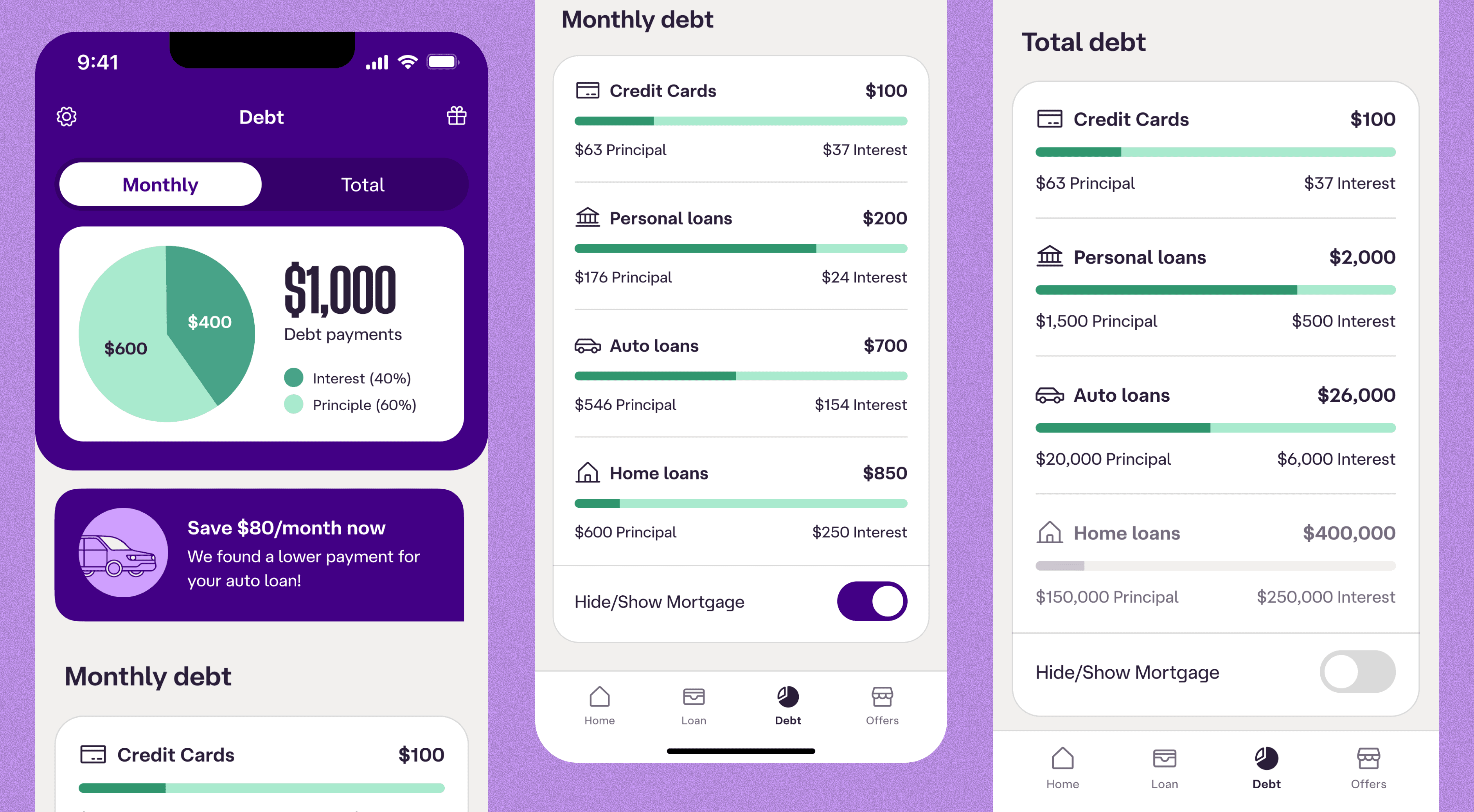
I designed a clear, actionable debt dashboard with:
Debt Breakdown Chart (interest vs. principal)
Unified Monthly Debt List covering credit cards, loans, auto, mortgage
Contextual insights (e.g., “Save $80/mo with a lower rate”)
Multiple states to reflect real user scenarios (with/without mortgage, high/low debt, insights on/off)
Built with Ava’s design system for consistency and readability.
The solution
I designed a clear, actionable debt dashboard with:
Debt Breakdown Chart (interest vs. principal)
Unified Monthly Debt List covering credit cards, loans, auto, mortgage
Contextual insights (e.g., “Save $80/mo with a lower rate”)
Multiple states to reflect real user scenarios (with/without mortgage, high/low debt, insights on/off)
Built with Ava’s design system for consistency and readability.
The solution
I designed a clear, actionable debt dashboard with:
Debt Breakdown Chart (interest vs. principal)
Unified Monthly Debt List covering credit cards, loans, auto, mortgage
Contextual insights (e.g., “Save $80/mo with a lower rate”)
Multiple states to reflect real user scenarios (with/without mortgage, high/low debt, insights on/off)
Built with Ava’s design system for consistency and readability.
Impact
Impact
Impact
+36%
+36%
+36%
in refinancing/savings offer clicks
in refinancing/savings offer clicks
in refinancing/savings offer clicks
+27%
+27%
+27%
user confidence about debt
user confidence about debt
2x
2x
2x
more engagement with debt features
more engagement with debt features
Rent Reporting - designing a high-impact feature from 0
Rent Reporting - designing a high-impact feature from 0
Rent Reporting - designing a high-impact feature from 0
The opportunity
When I joined Ava, Rent Reporting wasn’t part of the product at all, but early research showed it had strong potential for our user base. A large portion of Ava members were renters with thin credit files, and industry data confirmed that rent is one of the highest-impact payments you can add to a credit history.
Support trends also showed that users were looking for ways to build credit faster without taking on new debt. Competitors offered rent reporting, but the flows were confusing, overly manual, and lacked any sort of transparency.
This made the opportunity clear:
if we could design a simple, guided Rent Reporting experience, it could deliver fast credit improvement and significantly boost Ava’s product value.
The opportunity
When I joined Ava, Rent Reporting wasn’t part of the product at all, but early research showed it had strong potential for our user base. A large portion of Ava members were renters with thin credit files, and industry data confirmed that rent is one of the highest-impact payments you can add to a credit history.
Support trends also showed that users were looking for ways to build credit faster without taking on new debt. Competitors offered rent reporting, but the flows were confusing, overly manual, and lacked any sort of transparency.
This made the opportunity clear:
if we could design a simple, guided Rent Reporting experience, it could deliver fast credit improvement and significantly boost Ava’s product value.
The opportunity
When I joined Ava, Rent Reporting wasn’t part of the product at all, but early research showed it had strong potential for our user base. A large portion of Ava members were renters with thin credit files, and industry data confirmed that rent is one of the highest-impact payments you can add to a credit history.
Support trends also showed that users were looking for ways to build credit faster without taking on new debt. Competitors offered rent reporting, but the flows were confusing, overly manual, and lacked any sort of transparency.
This made the opportunity clear:
if we could design a simple, guided Rent Reporting experience, it could deliver fast credit improvement and significantly boost Ava’s product value.
My process
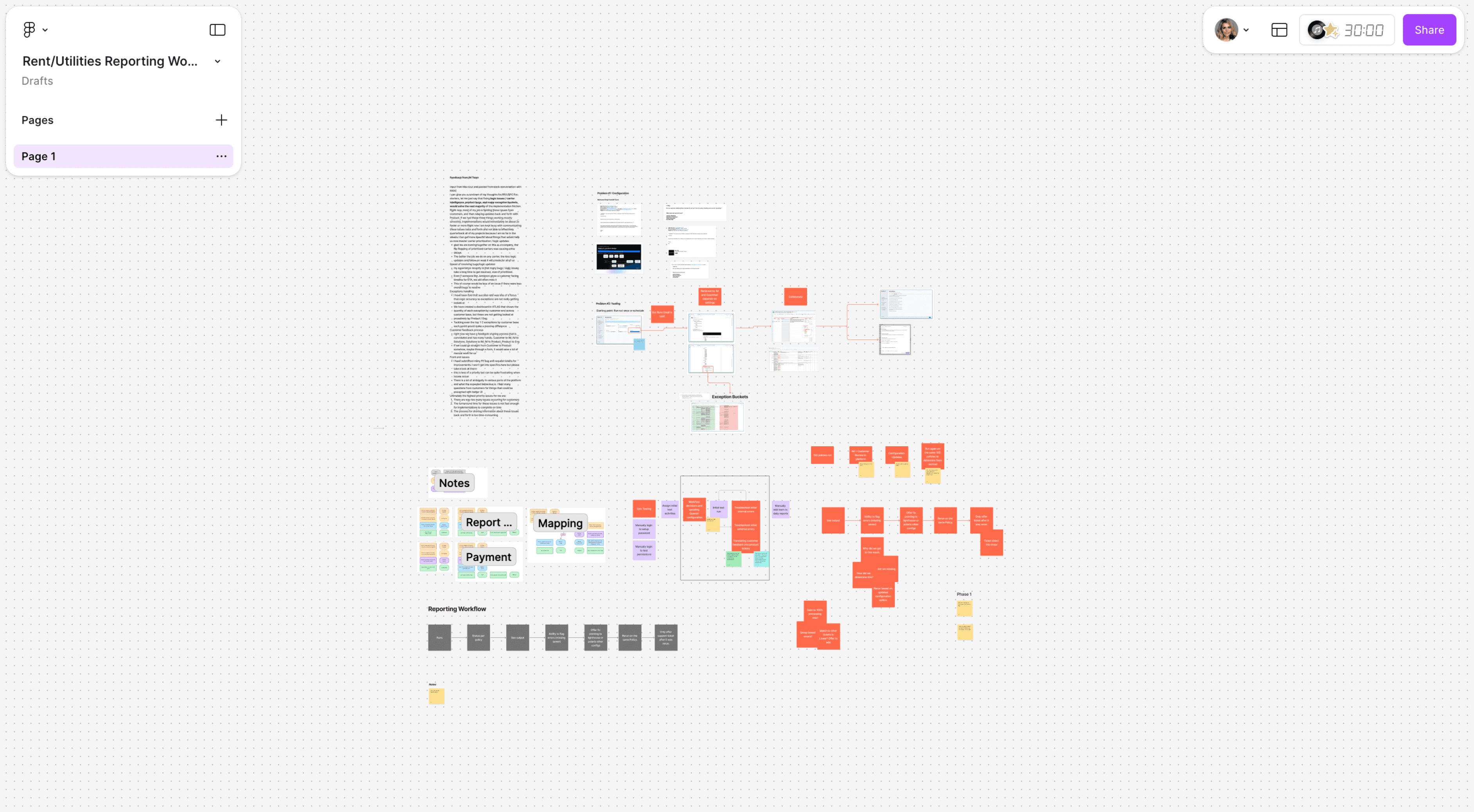
Because Rent Reporting didn’t exist in the app, my first step was defining the entire system end-to-end.
I started with the real-world constraints - bureau rules, partner requirements, and what engineering could reliably detect from bank data - and turned that into a user-friendly flow.
Key things that shaped the structure:
Start with the constraints.
I identified the minimum information we needed from users (address, rent amount, verification) based on bureau and backend rules.Design it as a monthly product, not a one-time setup.
Rent is reported every month, so I modeled the feature around ongoing value.
That’s why the month-by-month history became a core part of the design.Make backend processes visible.
Reporting happens behind the scenes and usually creates confusion.
I translated backend outcomes into clear, user-facing states: reported, pending, failed, missing info.Plan for multiple entry points.
Rent Reporting needed to fit naturally whether a user had:just the Card
Card + Loan
or all credit products
So I created multiple Home tab variations and modular UI blocks.
Align with business value.
The rent amount and potential score impact informed where personalized upsell opportunities made sense.
This phase was mostly systems and flows - defining how a completely new credit feature should work inside Ava.
My process
Because Rent Reporting didn’t exist in the app, my first step was defining the entire system end-to-end.
I started with the real-world constraints - bureau rules, partner requirements, and what engineering could reliably detect from bank data - and turned that into a user-friendly flow.
Key things that shaped the structure:
Start with the constraints.
I identified the minimum information we needed from users (address, rent amount, verification) based on bureau and backend rules.Design it as a monthly product, not a one-time setup.
Rent is reported every month, so I modeled the feature around ongoing value.
That’s why the month-by-month history became a core part of the design.Make backend processes visible.
Reporting happens behind the scenes and usually creates confusion.
I translated backend outcomes into clear, user-facing states: reported, pending, failed, missing info.Plan for multiple entry points.
Rent Reporting needed to fit naturally whether a user had:just the Card
Card + Loan
or all credit products
So I created multiple Home tab variations and modular UI blocks.
Align with business value.
The rent amount and potential score impact informed where personalized upsell opportunities made sense.
This phase was mostly systems and flows - defining how a completely new credit feature should work inside Ava.
My process
Because Rent Reporting didn’t exist in the app, my first step was defining the entire system end-to-end.
I started with the real-world constraints - bureau rules, partner requirements, and what engineering could reliably detect from bank data - and turned that into a user-friendly flow.
Key things that shaped the structure:
Start with the constraints.
I identified the minimum information we needed from users (address, rent amount, verification) based on bureau and backend rules.Design it as a monthly product, not a one-time setup.
Rent is reported every month, so I modeled the feature around ongoing value.
That’s why the month-by-month history became a core part of the design.Make backend processes visible.
Reporting happens behind the scenes and usually creates confusion.
I translated backend outcomes into clear, user-facing states: reported, pending, failed, missing info.Plan for multiple entry points.
Rent Reporting needed to fit naturally whether a user had:just the Card
Card + Loan
or all credit products
So I created multiple Home tab variations and modular UI blocks.
Align with business value.
The rent amount and potential score impact informed where personalized upsell opportunities made sense.
This phase was mostly systems and flows - defining how a completely new credit feature should work inside Ava.
Designing the simple, trust-first experience
Once the structure was clear, I focused on making the setup feel quick and predictable.
My design priorities:
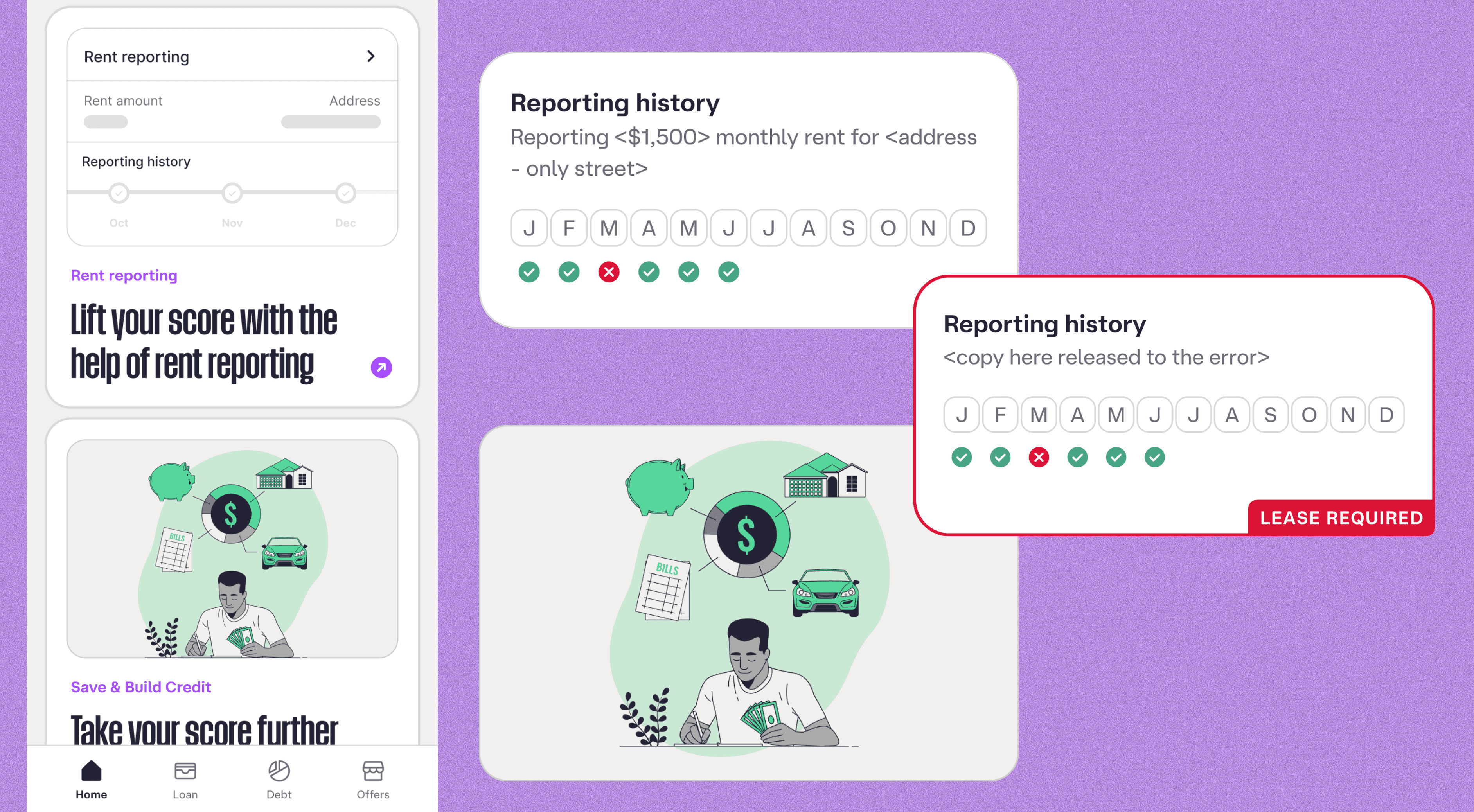
A clear month-by-month timeline so users can instantly see what has been reported.
Straightforward inputs (rent amount, address) with no unnecessary friction.
Human, plain-language explanations for each state.
“Recommended” labels to highlight the impact without over-educating.
Modular system components that fit Ava’s existing design system across multiple screens.
Guided error states so users know exactly how to fix issues.
The result is a feature that hides a lot of complexity behind a very simple, trustworthy UI - which is exactly what Rent Reporting requires.
Designing the simple, trust-first experience
Once the structure was clear, I focused on making the setup feel quick and predictable.
My design priorities:
A clear month-by-month timeline so users can instantly see what has been reported.
Straightforward inputs (rent amount, address) with no unnecessary friction.
Human, plain-language explanations for each state.
“Recommended” labels to highlight the impact without over-educating.
Modular system components that fit Ava’s existing design system across multiple screens.
Guided error states so users know exactly how to fix issues.
The result is a feature that hides a lot of complexity behind a very simple, trustworthy UI - which is exactly what Rent Reporting requires.
Designing the simple, trust-first experience
Once the structure was clear, I focused on making the setup feel quick and predictable.
My design priorities:
A clear month-by-month timeline so users can instantly see what has been reported.
Straightforward inputs (rent amount, address) with no unnecessary friction.
Human, plain-language explanations for each state.
“Recommended” labels to highlight the impact without over-educating.
Modular system components that fit Ava’s existing design system across multiple screens.
Guided error states so users know exactly how to fix issues.
The result is a feature that hides a lot of complexity behind a very simple, trustworthy UI - which is exactly what Rent Reporting requires.
Impact
+31% increase in successful Rent Reporting activations
Noticeable reduction in setup-related support questions
Higher long-term engagement due to the monthly reporting history
Opened a new upsell pathway tied to rent amount and predicted credit impact
For many thin-file users, this became their first meaningful credit improvement
Impact
+31% increase in successful Rent Reporting activations
Noticeable reduction in setup-related support questions
Higher long-term engagement due to the monthly reporting history
Opened a new upsell pathway tied to rent amount and predicted credit impact
For many thin-file users, this became their first meaningful credit improvement
Impact
+31% increase in successful Rent Reporting activations
Noticeable reduction in setup-related support questions
Higher long-term engagement due to the monthly reporting history
Opened a new upsell pathway tied to rent amount and predicted credit impact
For many thin-file users, this became their first meaningful credit improvement